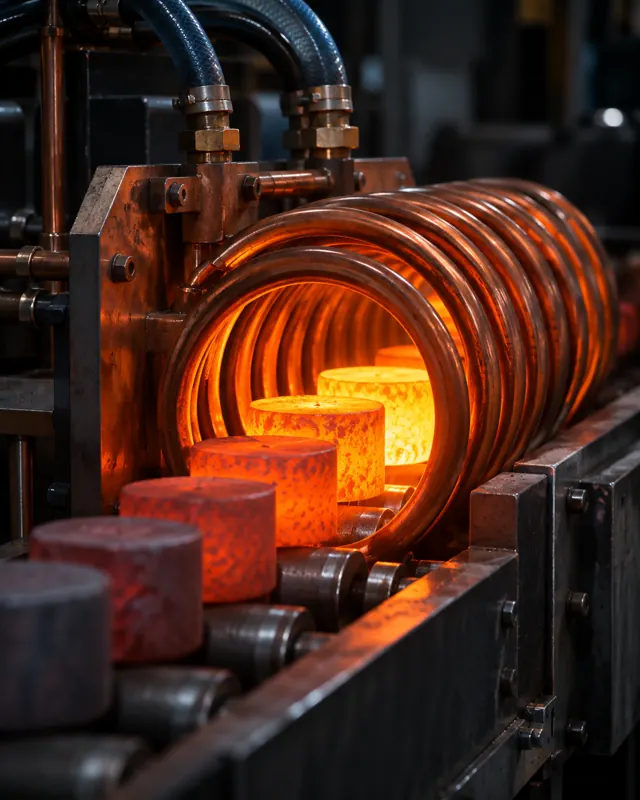
OP 20 · 1250 °C
Heating
Induction heating: less scale and energy than a gas furnace, with consistent temperature control to the second.
Nine operations from cutting to dispatch, in one factory. Heating, forging, heat treatment and machining feed into one another on the same line.
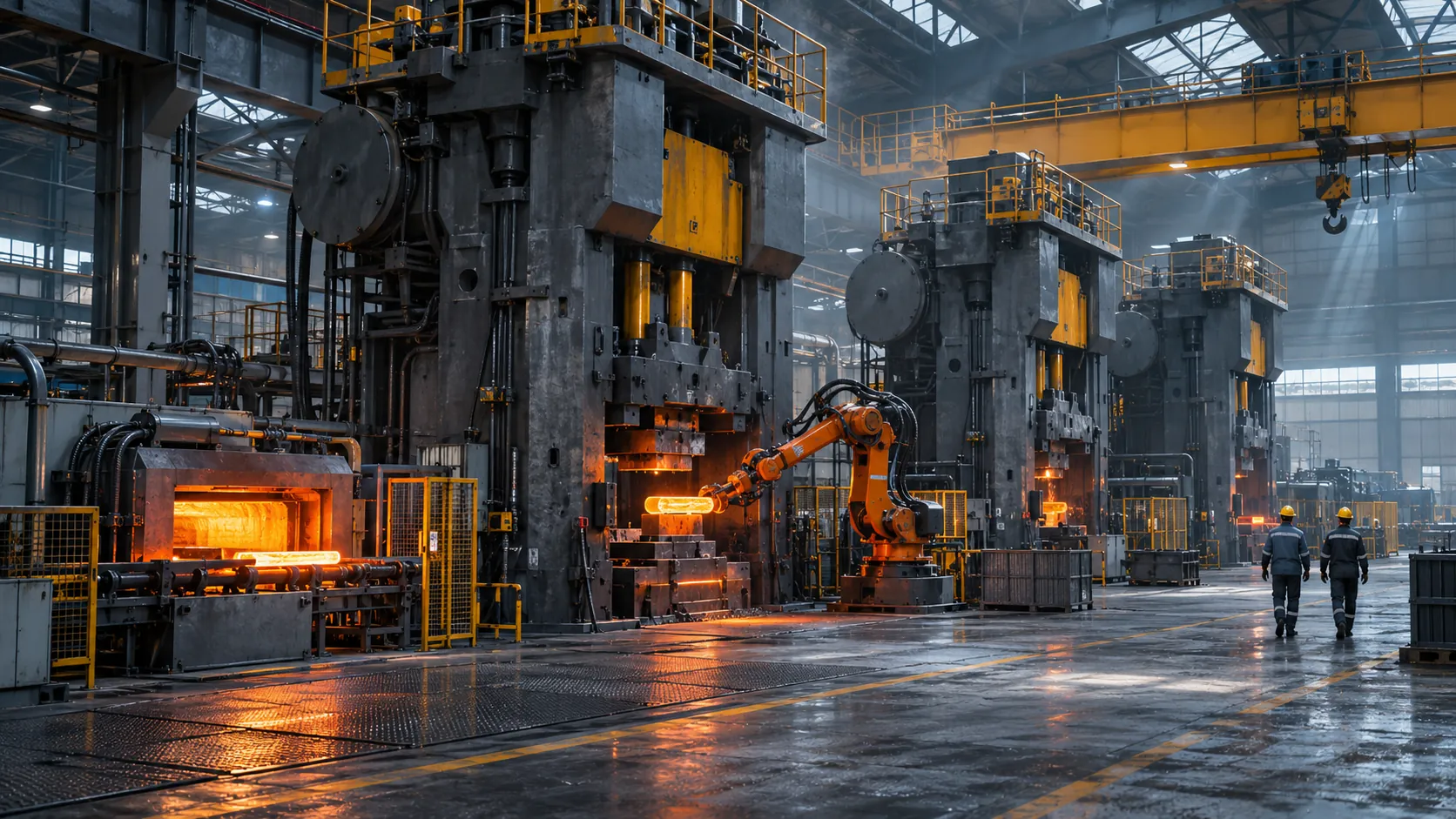
Four critical steps. The full route is on the home page; each step’s temperature appears on the left-hand scale.
OP 20 · 1250 °C
Induction heating: less scale and energy than a gas furnace, with consistent temperature control to the second.
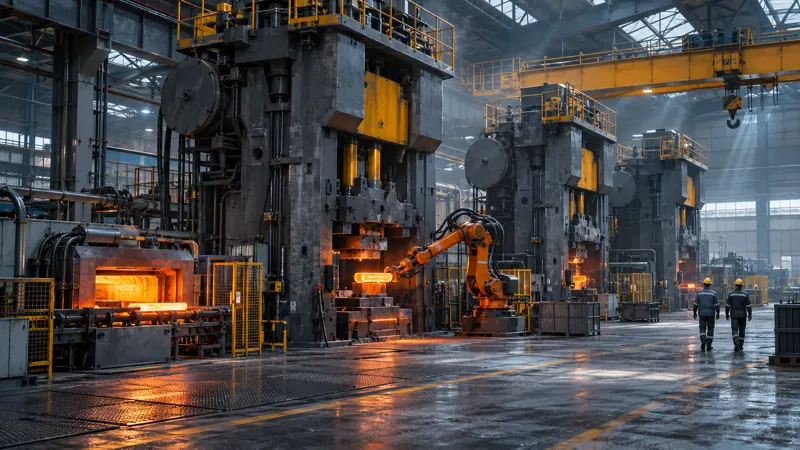
OP 30 · 1200 °C
Closed-die forging in two or three stages. The robot transfers the part between dies in seconds.
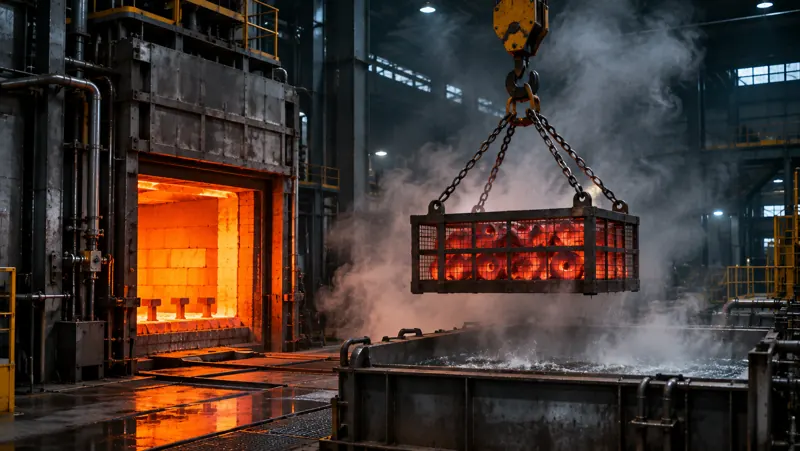
OP 50 · 850 °C
Quenching and tempering, normalising, isothermal annealing. The temperature curve of every heat is recorded.
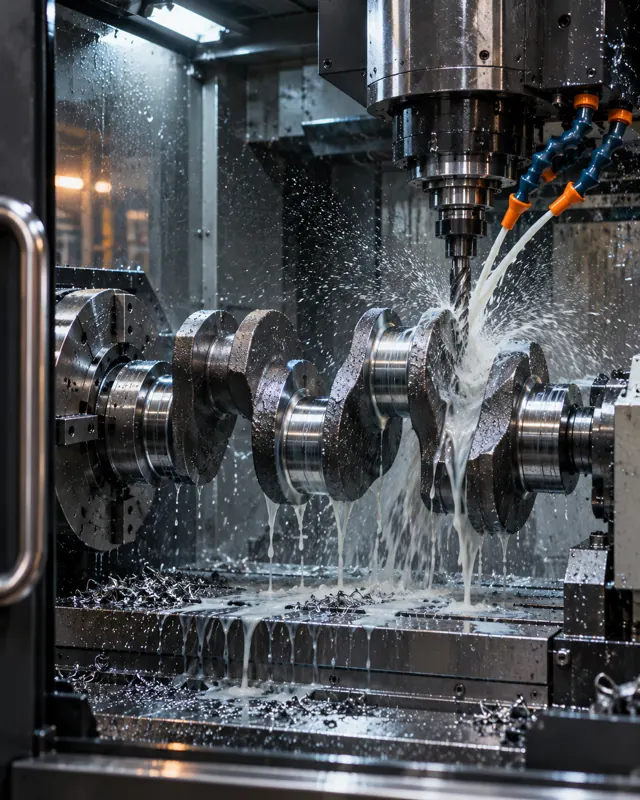
OP 60 · 20 °C
24 CNC centres deliver forged parts ready for assembly.
Part envelope
Contact us about drawings outside these limits too; die and line adaptations are often possible.
Main equipment list.
| Line | Equipment | Capacity | Year |
|---|---|---|---|
| Press lines 01–02 | Mechanical forging press | 2 × 1 600 t | 1988 / 2001 |
| Press line 03 | Mechanical forging press, robotic | 4 000 t | 2026 |
| Press lines 04–05 | Mechanical forging press | 2 × 2 500 t | 2008 / 2014 |
| Press lines 06–07 | Screw press | 2 × 1 600 t | 2016 / 2019 |
| Heating | Induction heater | 7 units · 400–1,200 kW | 2008–2026 |
| Heat treatment | Continuous quenching and tempering furnace + quench tank | 3.5 t/hr | 2018 |
| Machining | CNC turning and milling centre | 24 units | 2004–2025 |
| Toolroom | 5-axis CNC, EDM | Dies: 600 sets per year | 2012–2024 |
Transfer robot, press line 03
Capacity
Next step
Send your drawing.A STEP, IGES or PDF drawing, annual volume and material are all we need. An engineer responds, rather than a sales representative.